One way to look at decluttering is that it is a long series of decisions. Many of them are straightforward. But we can get stuck on some, and those are the ones that often mean a decluttering project stalls.
This article is for both kinds of decisions, the straightforward and the tricky ones. Some of what's here applies to the simple choices, like whether to keep a kitchen gadget you haven't used in two years. Other parts are more useful when the decisions are complex, when other people's needs are involved, when you're sorting through sentimental items or family heirlooms, or when you're navigating the significant emotional task of downsizing.
If you've ever been fearful of approaching a doom pile or stood holding something and felt stuck, this is for you.
Practice Acceptance: You’ll Never Have All the Information
One of the most freeing things to acknowledge is that you can't know everything. There is a place for taking the time to gather a bit more information if you need it, but there will always be things you don't know and things you don't even know you need to know.
The most common version of this in decluttering is the question: “What if I need it one day?”. We can't know the future, but we can look at the past. Ask yourself:
Have I needed this item in the last year? The last five years?
How realistic is it that I’ll need it in the future?
If I did need it, how easy would it be to replace or borrow?
These questions are helpful if you tend toward "just in case" keeping. I've written more about that pattern in "Just-In-Case" Clutter, check it out if this is a pattern you notice in yourself.
Our brains are also wired to overestimate the likelihood of needing something simply because we can vividly imagine the scenario, (this is due to a pesky cognitive bias called the availability heuristic) and is a reason clutter gets stuck in our homes. Noticing it doesn't make the feeling go away, but it can give you a nudge to pause and make an intentional choice.
Get Clear on Your Values
Our values are always in the background of our decisions, often without us realising it. When you're stuck on an item, pause and ask: which of my values are actually at work here?
Maybe you value sustainability, and it feels wasteful to let something go. Maybe you value family relationships, and an item feels like a connection to someone you've lost. Maybe you value simplicity, and you're ready to create more space, but another part of you values expressing yourself through all the unique decor pieces you’ve collected over the years and the two are pulling you in different directions.
No values are wrong. But at certain points, some values will get you closer to your goal than others. It helps to name the competing values clearly then reflect and ask yourself which one matters more right now?
Values can also get out of balance over time, especially after significant life changes. Sometimes what felt important to keep five years ago no longer reflects who you are today. That's not wrong, it’s ok to allow ourselves to change.
Consider All Your Options
When a decision feels complex, one of the most helpful things you can do is ask openly: “What could I do here? “. Not what “should” I do or thinking simplistically in terms of just "keep or let go," but genuinely exploring the range of options.
Could it be passed on to a specific person who would use and love it?
Could it be photographed and then passed on?
Could it be stored somewhere less prominent while you sit with the decision a little longer?
Could part of it be kept, rather than all of it?
Moving away from either/or thinking creates more flexible thinking. Real life decisions are rarely just between two clear right and wrong options, and acknowledging that can reduce the pressure significantly.
When you're exploring options, try to stay grounded in the real world. Think about the actual, human consequences of each choice, not just the ideal outcome. Which leads to the next point…
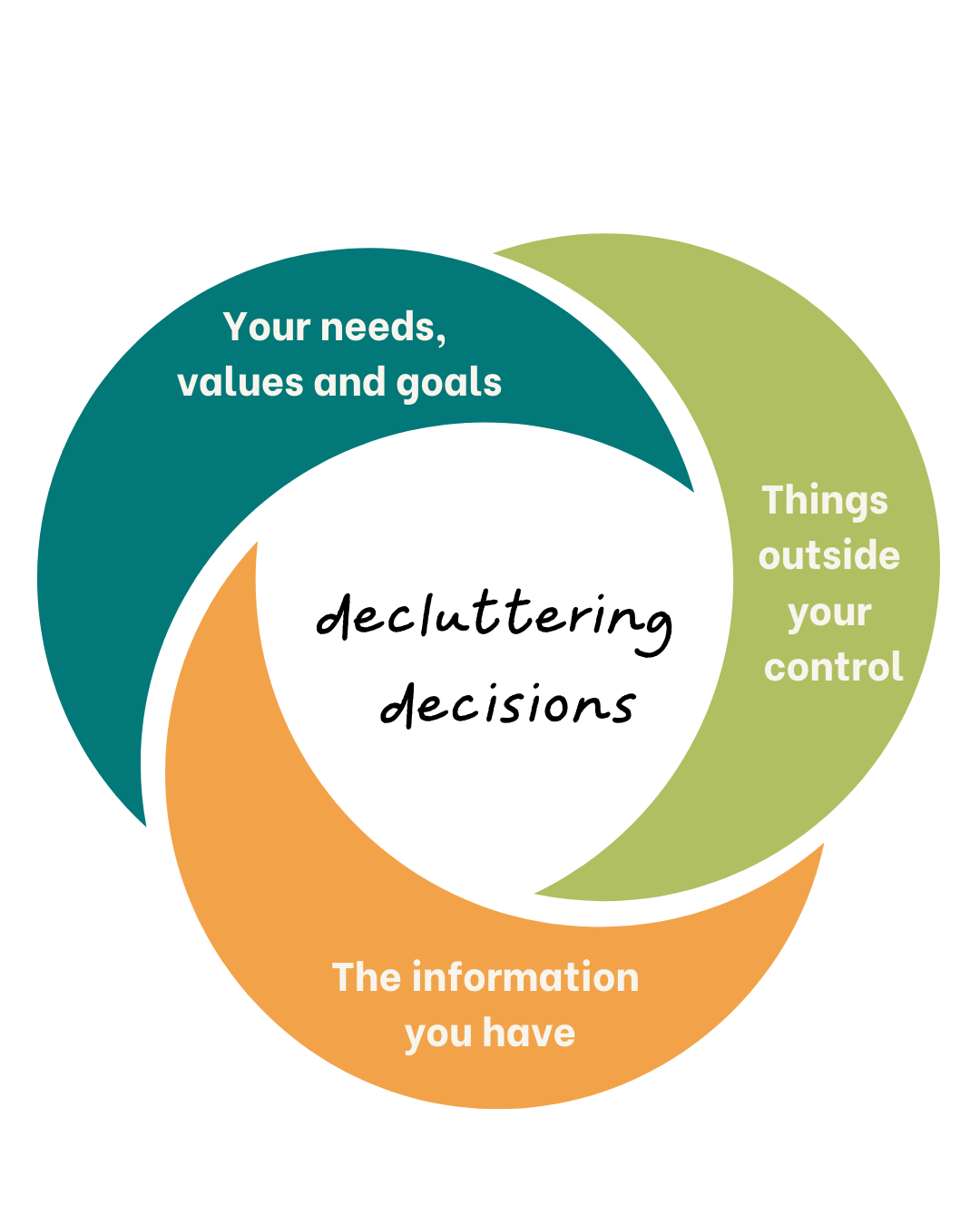
It’s not always a clear cut “Right” or “Wrong” decision. There are many factors that work together in your decluttering decisions.
Ideal World vs Real World
It's worth separating out what you'd do in an ideal world and what your options are in the reality of a complex, messy world.
In an ideal world, you might have unlimited storage, a close family member who wants the heirloom, or the time and energy to restore something. In the real world, storage has limits, family dynamics are complicated, and time is finite. Thinking about things from these different perspectives can be helpful. Giving yourself permission to think about the ideal allows you to understand why the compromises may cause discomfort. And then grounding the choice in reality helps you understand which compromises you might need to make so you can get to a decision.
Balance Your Needs With Others' Needs
Some decisions don't only belong to you. Shared spaces, inherited items, and family objects often involve other people's feelings and needs, but consider carefully about what your real obligations are.
There's a difference between genuine obligation, to a partner, a child, or a co-owner of a property, and a felt sense of obligation that may actually be more about guilt, fear of conflict, or someone else's expectations. Being clear on which is which can help you make decisions that are fair to everyone, including yourself.
A useful reflection question in this situation is: what would you say to a close friend who was weighing up the same choice? Often we show a level of compassion and understanding to others that we don't give to ourselves.
Watch for Fear and Anxiety in the Driver's Seat
This is something I’ve spent a lot of time reflecting on, both professionally and personally. I try not to make decisions from a place of anxiety or fear. I don't always succeed, but it’s something I am mindful of.
When a decision brings up unpleasant emotions, old memories, or fears, it’s helpful to acknowledge them. But they're not always the most reliable guide to what's actually the right choice for you right now. If you notice strong anxiety or distress around a particular item, it might be good to take some more time on that decision, reflecting on it more deeply before making the call.
If you're interested in understanding more about what drives our decisions during decluttering, the article What's Guiding Your Decluttering: Anxiety, Aspiration, or Authenticity? goes into this in more depth.
Short-Term vs Long-Term Consequences
Our brains naturally favour what feels better right now. This is called temporal discounting, and it means present discomfort tends to outweigh future relief. What that means is that if we feel discomfort when decluttering we’ll pay more attention to that than the goal of the uncluttered space we are working towards.
It's why decluttering can feel so hard in the moment, even when we know the outcome we're working toward. Keeping something to avoid the discomfort of deciding is a very human response. But try asking yourself:
“What are the long-term consequences of keeping this?”
and
“What are the long-term consequences of letting it go?”
Not every decision has high stakes. But for the ones that do, considering both timeframes often brings a different perspective than focusing only on how something feels right now.
Get Support If You Need It
Complex decisions may be easier with someone supportive beside you. A trusted friend who can body-double you through the process, listen to your thoughts as you weigh up the options, (but hold back their own opinions), can make a big difference. The key is that you trust them, they are non-judgmental, and are genuinely there to help you work it through for yourself rather than to push their own views.
If you don't have that person, a professional organiser can fill that role. It’s an important part of what we do for our clients so we’ve had lots of practice. You can read more about how professional organising works if you're curious.
How to Know You've Made the Right Decision?
A few things can help you test whether a decision feels right for you;
Ask yourself: “Would I feel confident explaining how I made this choice to someone who knows and cares about me?” Not defending it, but simply explaining it. If the answer is yes, that's a good sign.
You can try writing down the options you considered, how you weighed it up, and what ultimately guided your choice. The act of writing it out often makes the reasoning clearer, and it gives you something to return to if doubt creeps in later.
Another option, particularly for significant decisions, is to write a short letter to your future self as if you'd made each of the possible choices. Describe what that looks like a year from now. Maybe one feels more aligned with what you’re working towards.
A Few Things Worth Remembering
Avoiding a decision is a decision in itself. Leaving something in the "maybe" pile indefinitely has consequences for your space, your energy, and your progress.
A maybe is a no until it becomes a yes.
For some people the goal is simply a clear space at the end, but for others, the decluttering process itself is a journey of growth. This is because to get to their goal they’ll have to work through things from the past, face fears and work through old patterns of thinking.
Whatever the motivation, being mindful of the decision making process can help you feel good about the choices you make in the long term.
Key Points:
You won't have perfect information, and that's okay. Use your past experience to assess the likelihood of future need.
Name your values clearly, especially when they compete with each other. Ask which matters more right now.
Open up beyond keep or let go. Ask "what could I do?" and explore realistic options.
Separate what you'd do in an ideal world from what makes sense in your actual life.
Be honest about which obligations are real and which come from guilt or fear of conflict.
Notice if anxiety or fear is driving the decision. It's worth acknowledging those feelings without always letting them decide.
Consider both short-term and long-term consequences. Our brains tend to overweight the present.
Get support. A trusted friend or professional organiser can help you work through complexity without pushing you in a direction.
Test your decision by asking whether you'd feel comfortable explaining it to someone who knows and cares about you.
Avoiding a decision is a decision. A maybe is a no until it's a yes.
Looking for more help, ideas or encouragement?
Free Downloads:
5 Things Creating Clutter – Resource to help you deal with common clutter causes
Clutter and Mental Health Infographic - Easy-to-read with key research insights, myth-busting facts, and tips to get started.
Related Blog Articles:
What’s Guiding Your Decluttering: Anxiety, Aspiration or Authenticity?
The psychology of stuff. Are you trying to use possessions to meet your deepest needs?
In-Depth Guides:
Creating Calm Spaces eBook – Comprehensive guide with organising systems and strategies ($14.95)
Home Systems Workbook – Simple activities to organise routines and reduce chaos ($9.95)
Newsletter:
A Calm Year - Tips and resources to help you declutter and organise
Connect:
Need Hands-On Help with Decluttering in Brisbane?
If you'd like support navigating the emotional and practical parts of decluttering and organising, learn more about how we can work together. Calm Space Professional Organising serves the Brisbane area.
Not in Brisbane?
Virtual Sessions can provide personalised help wherever you are.